
Natural vs Synthetic Energy: What's Actually Different?
The natural vs synthetic debate is more nuanced than most wellness brands want you to believe.
Walk into any health food shop and you'll see "natural" plastered on everything. Natural energy. Natural focus. Natural calm. The implication is clear: natural equals better, synthetic equals suspect. It's a compelling narrative, and it's oversimplified to the point of being misleading.
The truth is more interesting, and more useful, than either side of the marketing war admits.
Some Inconvenient Chemistry
Here's a fact that makes wellness marketers uncomfortable: caffeine is caffeine. The molecule C₈H₁₀N₄O₂ from a coffee bean is structurally identical to one synthesised in a laboratory. Your adenosine receptors cannot tell the difference.
This is true for most isolated compounds. Synthetic vitamin C is the same molecule as vitamin C from an orange. When an energy drink puts "natural caffeine from green tea" on the label, that's marketing, not pharmacology.
This is where most debunking articles stop. Natural and synthetic are the same, case closed. But that conclusion misses something important.
The Matrix Matters
Isolated compounds are identical. But substances rarely arrive in your body alone. Coffee doesn't just deliver caffeine, it delivers caffeine alongside chlorogenic acids, diterpenes, and hundreds of other bioactive compounds that modulate absorption and metabolism. This is why coffee and a caffeine pill feel different at equivalent doses.
The L-theanine naturally present in green tea alongside its caffeine produces a measurably different neurological effect than caffeine alone, smoother onset, less anxiety, more sustained attention. The combination wasn't engineered. It evolved.
Synthetic products can replicate this by combining isolated compounds. But the more compounds in a natural matrix, the harder it becomes to reverse-engineer the full effect profile.
How Stimulants Actually Work
Most conventional energy products operate through one mechanism: they block adenosine receptors, preventing the "I'm tired" signal from getting through. Guarana does the same thing, it's just caffeine in a different hat. The result is a borrowed-energy model. You're not creating energy; you're blocking the perception of fatigue. When the caffeine wears off, it all hits at once.
Aromatic herbs work through a fundamentally different pathway. When you inhale menthol, eucalyptol, or camphor, they don't enter your bloodstream in meaningful quantities. They interact with your nervous system through two routes: the olfactory nerve (smell) and the trigeminal nerve (sensation).
The olfactory nerve connects directly to the limbic system, the brain's arousal centre. Aromatic stimulation can shift alertness and cognitive state without altering blood chemistry. The trigeminal nerve responds to cooling (menthol) and warming (camphor), creating a reflexive alertness response similar to splashing cold water on your face.
No adenosine blockade. No borrowed energy. No crash. The tradeoff is that the effect is less potent and shorter-lived. But it's immediately repeatable without cumulative side effects.
When Natural Is Actually Better
The honest answer to "is natural better?" is: it depends on what you're optimising for.
If you need to stay awake for a 14-hour shift, caffeine is the better tool. No herbal inhaler overrides genuine sleep deprivation. But most energy dips, the 3pm slump, the post-lunch fog, the midnight fade at a party, don't require heavy pharmacological intervention. They require a nudge.
For nudges, the aromatic pathway has real advantages. No tolerance buildup, caffeine's effectiveness decreases with regular use; aromatic compounds don't trigger this adaptation. No sleep disruption, caffeine has a 5-6 hour half-life, while inhaled aromatics clear in minutes. No dependency, regular caffeine users get withdrawal headaches; there's no equivalent for aromatic stimulation. No cardiovascular load, caffeine raises heart rate and blood pressure; aromatic inhalation doesn't.
The Honest Position
An herbal inhaler doesn't replace your morning coffee. They operate through different mechanisms and serve different purposes. But "energy" isn't a single thing. It exists on a spectrum from "I need to not fall asleep at the wheel" to "I want to feel slightly more present." For the heavy end, conventional stimulants work. For the lighter, more frequent end, the dozens of small moments where you want a reset without a commitment, aromatic herbs offer effect without debt.
Natural isn't inherently better. But sometimes the natural mechanism is the right one for the job. Knowing the difference is more useful than picking a team.
Get First Access
Be first to buy BLYSS online. Sign up for launch access.
Related Articles
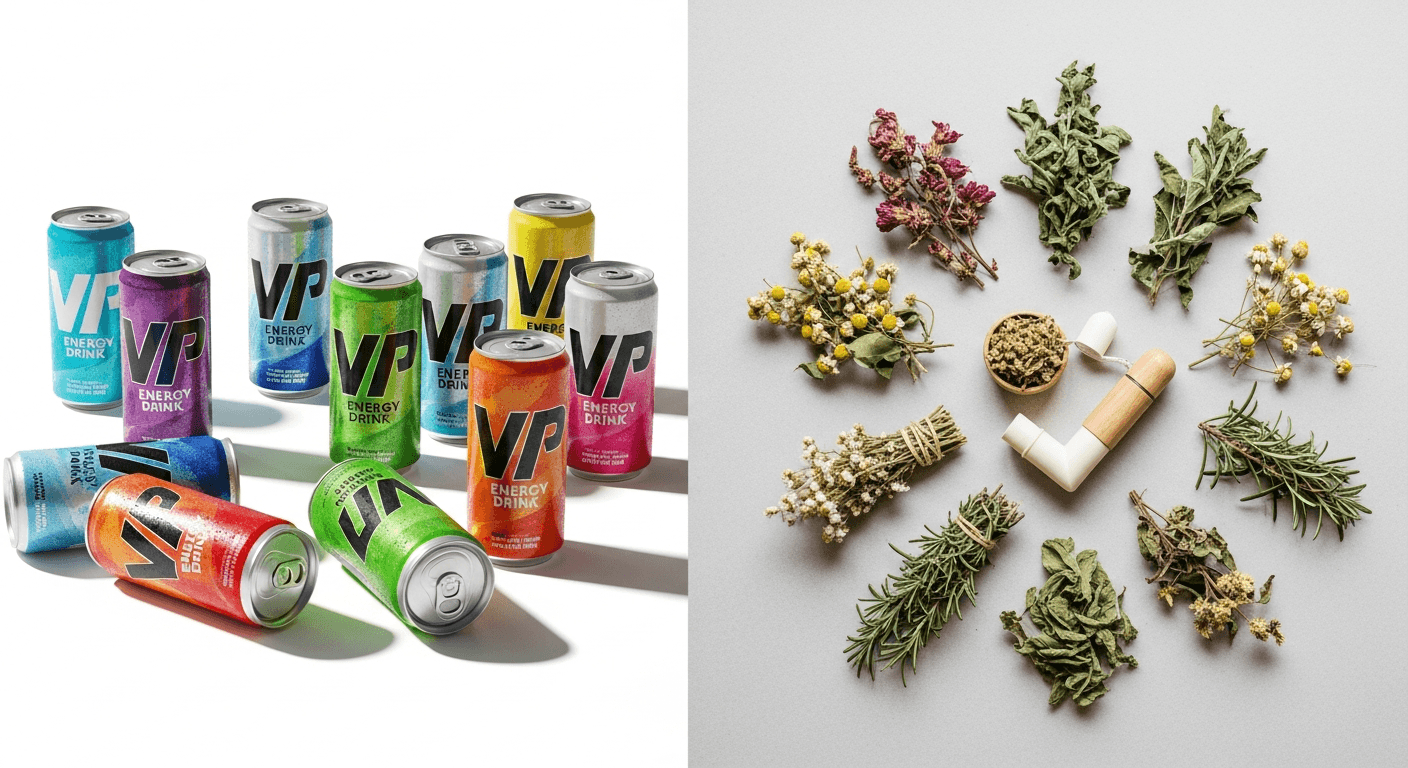
Herbal Inhalers vs Energy Drinks, A Real Comparison
How do herbal nasal inhalers compare to energy drinks for staying alert? We break down the ingredients, effects, costs, and trade-offs of each approach.

5 Spices That Actually Give You Energy
Forget caffeine pills. These five spices have been used as natural stimulants for centuries, and the science explains why they work.